
The Omega Seamaster Regatta is not the sort of watch that makes its character obvious through a familiar case shape or a traditional mechanical movement. Its large titanium case, mixed analogue and digital display, and four prominent pushers give it a very different appearance from most sports watches. At first glance, the dial can seem unusually busy. Once its purpose becomes clear, however, the arrangement starts to make sense.
Omega introduced the Seamaster Regatta in 2024 to mark the 37th America’s Cup in Barcelona. Rather than producing another conventional diving watch with a commemorative dial, the brand developed a multifunctional instrument intended for the demands of sailing. The distinction remains important in 2026. This is not simply an older release that needs another round of specifications repeated. It is a useful example of what happens when a watch is designed around a specific activity instead of a general idea of luxury sports watch styling.
For readers of UK Watch Store, the Regatta also offers an interesting way to understand the differences between a watch’s appearance and its underlying construction. Its identity comes from the relationship between the display, controls, movement and intended use. Those elements need to be considered together, particularly when comparing an original reference with a replica interpretation that may reproduce the exterior without sharing the same technology.
The first thing that deserves attention is the size. The authentic Seamaster Regatta measures 46.75mm across, 50mm from lug to lug and 15.6mm thick. Those figures put it firmly in the substantial sports watch category. Grade 5 titanium helps limit the weight, with Omega listing the complete watch at approximately 89 grams, but the case still occupies a considerable amount of wrist space.
That distinction between weight and size is worth understanding. A lightweight watch can feel less tiring than a similarly sized steel model, but it does not necessarily wear small. The case dimensions, the shape of the underside and the way the integrated rubber strap extends from the body all influence the overall footprint. For someone accustomed to a compact three hand watch, the Regatta will remain a conspicuous presence even though titanium keeps its weight relatively low.
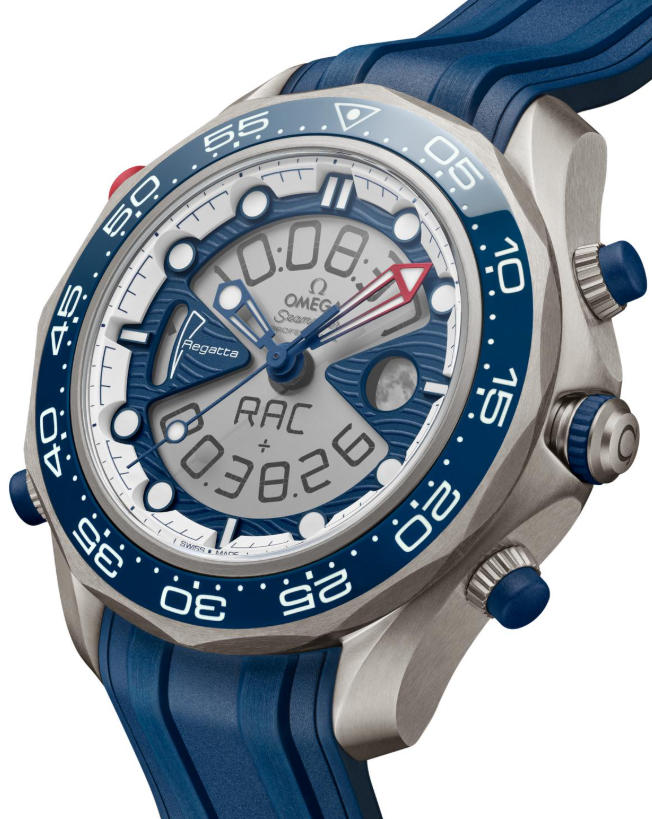
There is a practical reason for those proportions. The display needs room for both analogue timekeeping and a range of digital readings, while the controls must remain accessible. A smaller case might look more conventional, but it would also make the information and controls harder to accommodate without compromising the layout. The design therefore prioritises visibility and function over discretion.
The material choices support that purpose. Grade 5 titanium provides a strong case without the weight associated with a comparable steel construction. The blue ceramic bezel ring and integrated blue rubber strap create a consistent colour scheme, while the single red pusher stands apart from the three blue controls. These details give the watch a technical appearance, but their value lies in the way they help organise the design rather than simply making it look more complicated.
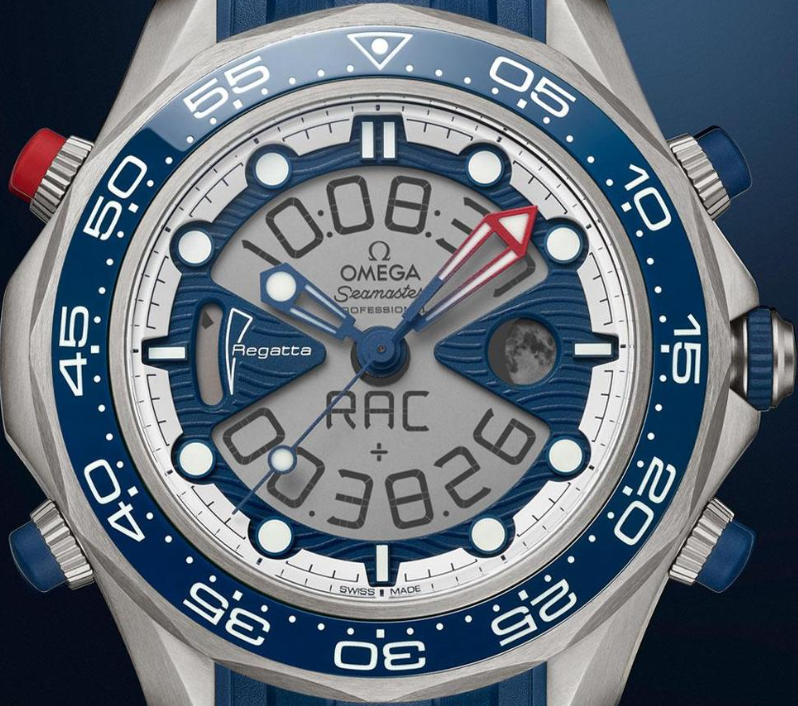
The dial is where the Regatta differs most clearly from a conventional Seamaster. Traditional hands display the time, while the LCD screen provides additional information. This combination gives the wearer a familiar analogue reference without sacrificing the flexibility of a digital interface. It also avoids the need to squeeze every function into a collection of small subdials, as might happen on a mechanical chronograph.
Omega has paid attention to legibility as well. The analogue hands can be moved clear of the digital display when the backlight is activated, helping prevent them from obscuring the information being read. It is a small but meaningful design decision. A multifunction watch is only useful when the wearer can understand its display quickly, especially when attention is divided between the watch and another task.
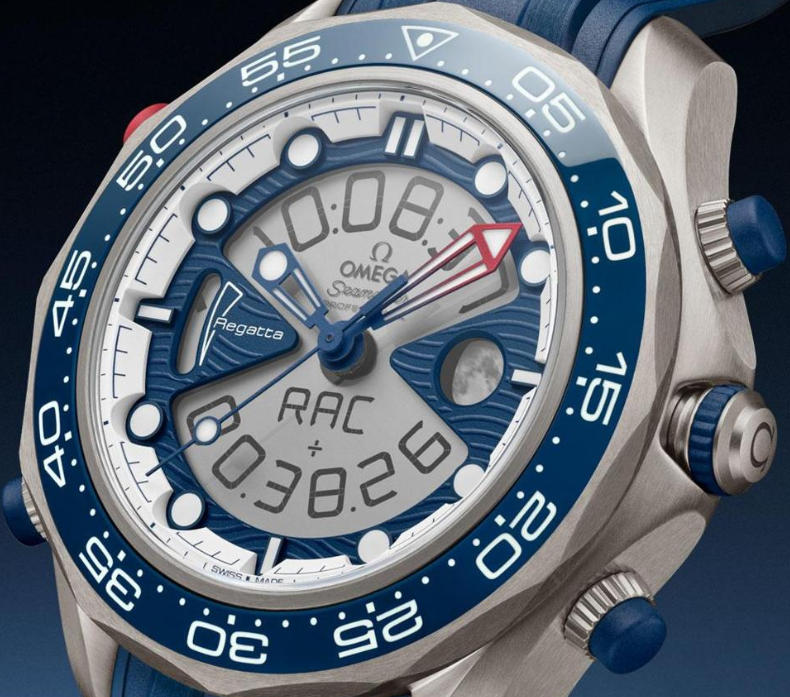
The four rubber covered pushers continue that functional approach. One is red and three are blue, providing a clear visual distinction between the controls. The sandblasted crown uses a push and turn operation to navigate the functions. Instead of making the watch resemble a conventional chronograph with a few extra buttons, Omega has given it an interface that reflects its more specialised role.
That interface also explains one of the Regatta’s potential drawbacks. A watch with this many functions requires some familiarity before it becomes easy to use. The controls, modes and display options are not immediately self explanatory, and the owner needs to understand how the different functions operate. For someone who regularly sails, that learning process may be worthwhile. For someone who mainly wants to check the time or measure an occasional interval, much of the additional capability may go unused.
This is where the Calibre 5701 becomes central to the story. The authentic watch uses a multifunctional quartz chronograph movement with a thermocompensated integrated circuit. Its functions include a chronograph, moonphase indicator, sailing logbook, temperature gauge, accelerometer, three alarms and a dedicated regatta race function. Omega also lists a battery life of approximately 31 months.
The quartz architecture is not an incidental choice. The Regatta is built around electronic functions that need to communicate information, manage timing sequences and support multiple display modes. Judging it only by the standards used for a traditional mechanical chronograph would miss the point. Its appeal comes from the combination of timekeeping and specialised tools rather than the complexity of a mechanical escapement.
The regatta countdown is particularly relevant to the watch’s intended audience. Competitive sailing involves a carefully timed sequence before the start, and a dedicated countdown can help the wearer follow that process. The logbook adds another layer of utility by providing a way to record information during a race. The alarms can provide audible reminders, while the temperature and acceleration functions expand the range of information available from the watch.
Not every function will be equally valuable to every owner, and that is an important distinction. A long specification list can make a watch look impressive, but the number of functions alone does not determine how useful it will be. The Regatta makes the most sense for someone who has a reason to use its timing and measurement features. For other wearers, the appeal may lie more in its unusual design and the fact that it represents a different approach to the Seamaster family.
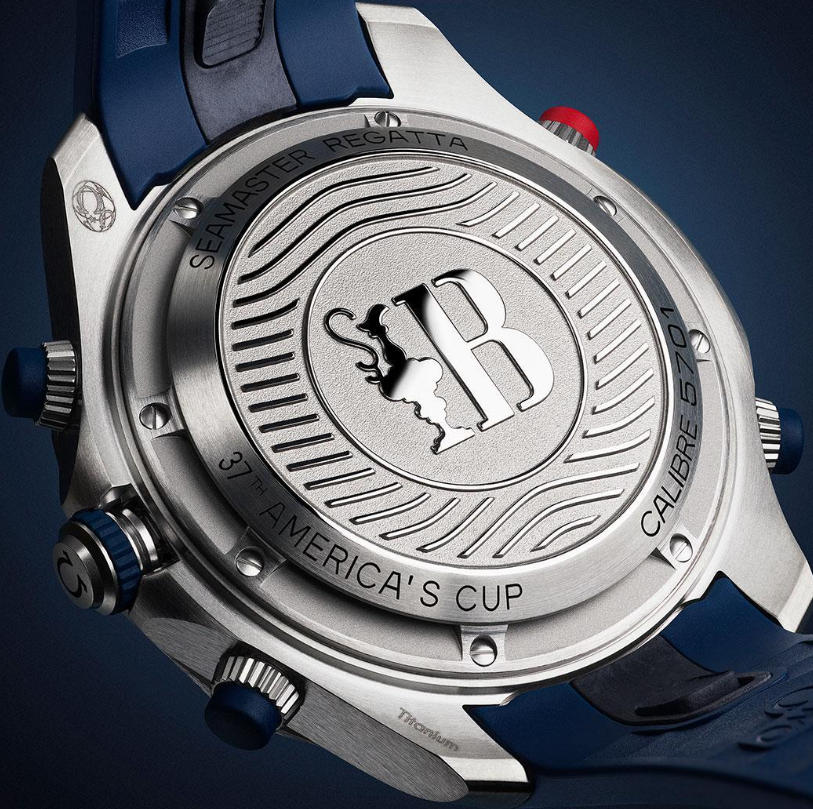
The caseback adds another detail that reinforces this identity. Omega uses a resonating cavity based on the principles of Helmholtz resonance to help increase the volume of the alarms. The back carries the 37th America’s Cup markings alongside the Seamaster Regatta name and the Calibre 5701 designation. This is more than a commemorative engraving. The construction contributes to the way the watch communicates information, which is consistent with its role as a specialised instrument.
The integrated blue rubber strap completes the design. It works with the blue bezel and pushers, while Omega’s Quick Change system allows the strap to be removed and replaced without the usual tools. The strap is a practical choice for a watch intended for use around water, although its presence should not be taken as evidence of a particular level of water resistance.
That last point matters because the Seamaster name covers watches with very different purposes. Omega lists the authentic Regatta at 50 metres of water resistance. It should not be confused with the Seamaster Diver 300M or treated as an equivalent diving watch simply because it shares some visual features with the wider collection. The Regatta’s emphasis is on sailing functions, digital information and timing, rather than the deeper water resistance associated with dedicated diving models.
Readers exploring Omega Seamaster replica watch articles can use this distinction as a starting point when comparing different designs. A shared brand name or a similar bezel does not mean that two watches have the same construction or are intended for the same activities. Understanding the original purpose of a model helps explain why its case, display and controls have been arranged in a particular way.
The same principle applies when looking at replica interpretations of the Seamaster Regatta. A watch may reproduce the large case, blue bezel, analogue hands, digital screen and coloured pushers without containing the same Calibre 5701 or offering the same electronic functions. Visual similarity and technical equivalence are separate questions, and one should never be used as proof of the other.
For visual comparisons, the most revealing areas are the case proportions, the placement of the LCD display, the shape and length of the hands, the spacing of the four pushers and the transition between the bezel and case. The strap connection and caseback design also contribute to the overall appearance. These details help explain whether an interpretation follows the original design coherently, but photographs cannot confirm the movement’s functions, long term reliability or water resistance.
Movement information deserves particular care. The authentic Calibre 5701 incorporates electronic functions and sensors that should not be assumed to exist in a replica merely because its dial looks similar. A product description should identify the movement actually fitted and distinguish working functions from decorative displays. If that information cannot be verified, it is better to treat the claim as unconfirmed than to assume the original specification has been reproduced.
Materials and water resistance require the same caution. A grey coloured case is not proof that it uses Grade 5 titanium, and a similar looking caseback does not demonstrate that it contains the same alarm system. Nor does an exterior resembling the authentic model establish that the watch has passed equivalent water resistance testing. Those are properties of the actual construction, not the design alone.
The Omega Seamaster Regatta remains an unusual proposition in 2026 because its strengths and limitations are closely connected. The large case provides space for a detailed interface, the titanium helps control weight, and the multifunctional quartz movement supports features that would be difficult to understand from appearance alone. The same choices also make the watch more specialised than a conventional sports model.
That is ultimately what makes the Regatta worth discussing. It is not trying to be the most restrained Seamaster or a universal everyday watch. It brings together a particular set of needs associated with sailing and expresses them through the display, controls and movement. Whether those functions are useful to an individual wearer depends on their interests, but the design has a clear purpose.
Seen this way, the Seamaster Regatta is best understood as a sailing instrument that happens to be worn on the wrist. Its significance lies not simply in the America’s Cup markings or the number of functions listed on the specification sheet, but in the way the different parts of the watch have been designed to work together. That is also the most useful perspective when comparing the original reference with watches inspired by its appearance.
Technical note: Specifications in this article refer to the authentic Omega Seamaster Regatta reference 216.92.46.79.10.001. Replica and third party interpretations may differ in movement, materials, functions, construction and water resistance.


